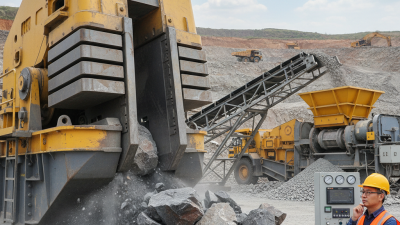
| Jaw Crusher |
Material is compressed between a fixed jaw and a moving jaw. The moving jaw repeatedly opens and closes to break the rock. |
Primary |
Hard and abrasive rock, blasted stone, recycled concrete, and large quarried material. |
Approximately 3:1 to 6:1 |
Coarse, angular product with a relatively wide size distribution. |
Simple design, reliable operation, strong performance on hard rock, and good tolerance for large feed sizes. |
Produces a less cubical product; discharge can contain more flaky particles than impact-based crushers. |
Quarries, mining operations, road construction, demolition recycling, and aggregate plants. |
| Gyratory Crusher |
A cone-shaped crushing head rotates eccentrically inside a concave bowl, continuously compressing the material. |
Primary |
Very large, hard, and abrasive run-of-mine ore or quarried rock. |
Approximately 4:1 to 7:1 |
High-volume coarse product with steady flow and consistent operation. |
Very high capacity, continuous crushing action, and efficient handling of large feed sizes. |
Large installation footprint, high capital cost, and limited suitability for small or intermittent plants. |
Large-scale mining, high-capacity quarrying, and mineral processing plants. |
| Cone Crusher |
Rock is compressed between a rotating mantle and a stationary concave liner. The gap controls the product size. |
Secondary Tertiary |
Hard, medium-hard, and abrasive stone that has already been reduced by a primary crusher. |
Approximately 3:1 to 6:1 per stage |
Well-graded, cubical-to-angular product with good control of the top size. |
Good product shape, high efficiency, adjustable closed-side setting, and strong wear resistance when properly configured. |
Requires controlled feed; sticky or clay-rich material can reduce performance and cause chamber problems. |
Manufactured sand, road base, concrete aggregate, railway ballast, and hard-rock quarries. |
| Horizontal Shaft Impact Crusher |
High-speed rotor blow bars throw the feed against impact plates, breaking it by repeated impact and collision. |
Primary Secondary |
Soft to medium-hard limestone, recycled concrete, asphalt, and other lower-abrasion materials. |
Approximately 10:1 to 30:1 |
Highly cubical product with a broad range of fines, depending on rotor speed and settings. |
High reduction in one stage, excellent particle shape, and effective removal of weaker or layered material. |
Wear costs can be high when processing very abrasive rock; excessive fines may be produced at high reduction ratios. |
Limestone production, concrete recycling, asphalt recycling, and aggregate shaping. |
| Vertical Shaft Impact Crusher |
Material is accelerated by a high-speed rotor and thrown against a rock shelf or impact surface, using rock-on-rock or rock-on-metal crushing. |
Tertiary Quaternary |
Pre-crushed rock, manufactured sand feed, and materials requiring particle shaping. |
Approximately 4:1 to 8:1 |
Highly cubical particles and manufactured sand with improved shape and surface texture. |
Excellent particle shaping, useful for sand production, and adaptable to different crushing chambers. |
Usually requires a controlled feed; energy use and wear can increase with abrasive feed and high rotor speed. |
Manufactured sand, premium concrete aggregates, asphalt aggregates, and fine crushing. |
| Roll Crusher |
One or two counter-rotating rolls draw material into a narrowing gap and compress or shear it between the roll surfaces. |
Secondary Tertiary |
Medium-soft to medium-hard materials with controlled feed sizes and moderate abrasiveness. |
Approximately 3:1 to 6:1 |
Relatively uniform product with limited over-crushing and a controlled top size. |
Low-fines operation, compact design, simple maintenance, and good control of product sizing. |
Not ideal for very hard, highly abrasive rock or feed containing large, unbreakable contaminants. |
Coal processing, soft stone, industrial minerals, fertilizer, and selected aggregate applications. |
| Hammer Crusher |
High-speed hammers mounted on a rotor strike the feed and force it through a grate or impact zone. |
Primary Secondary |
Soft to medium-hard, low- to moderate-abrasion materials such as limestone, gypsum, and some recycled products. |
Approximately 10:1 to 50:1 |
Fine to medium product with a relatively high proportion of fines. |
High reduction ratio, compact equipment, and the ability to produce fine material in a single stage. |
Rapid wear with abrasive rock; moisture and sticky feed can cause blockage or reduce throughput. |
Limestone processing, cement raw material preparation, gypsum, and selected industrial minerals. |
| Mobile Crushing Plant |
A mobile chassis integrates one or more crusher types with feeders, conveyors, and screening equipment for transport between work areas. |
Primary Secondary |
Quarried rock, construction and demolition waste, recycled concrete, and road-building material. |
Depends on the integrated crusher |
On-site aggregate with reduced hauling requirements and flexible product sizing. |
Fast relocation, reduced civil works, lower material transport distance, and flexible operation at multiple sites. |
May have lower capacity than comparable fixed installations; transport regulations and site access must be considered. |
Road construction, temporary quarry sites, demolition recycling, and infrastructure projects. |